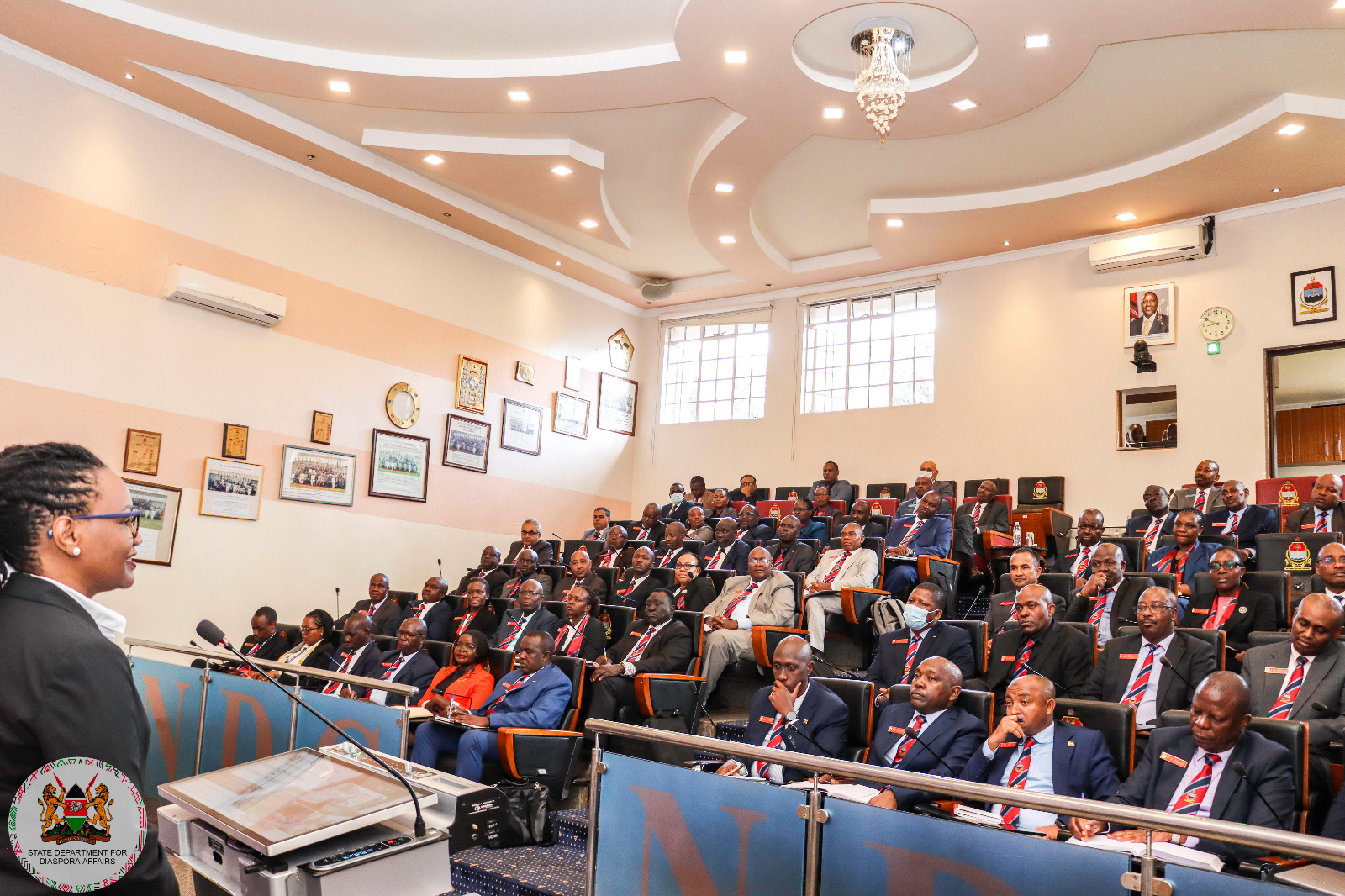
Tuesday, May 19, 2026(NAIROBI)___Ms. Roseline Kathure Njogu, CBS, Principal Secretary for Diaspora Affairs has said that the Kenyan diaspora is no longer peripheral to national security, noting that it is now part of the national security architecture itself.
The Principal Secretary made the remarks while delivering a lecture at the National Defence College Course 2025/26, Cohort 28, which brought together participants from over 16 countries. She observed that the traditional understanding of national security—rooted solely in borders, armies, and territorial sovereignty—is no longer sufficient in a world increasingly shaped by human mobility, digital networks, global labour markets, cross‑border financial flows, and transnational identities.
She noted that diaspora communities have evolved beyond being merely populations abroad or remittance senders, and are now strategic economic actors, geopolitical influencers, digital mobilization networks, soft power assets and humanitarian actors.
Drawing from global examples including Israel, India, China, and Rwanda, PS Njogu emphasized that countries which strategically engage and integrate their diaspora into national planning gain economic resilience, diplomatic influence, technological advancement and stronger national stability.
Kenya’s diaspora has become a critical pillar of economic security, with remittances rising to over USD 5.4 billion by 2025, surpassing earnings from key traditional exports such as tea, coffee and horticulture. Such financial flows strengthen household resilience, reduce economic vulnerability and contribute directly to national stability.
Additionally, the digital era has fundamentally transformed the security landscape, where diaspora Kenyans can amplify narratives online, mobilize international solidarity, engage foreign media and influence global discourse in real time.
PS Njogu noted that beyond remittances and investment, diaspora communities preserve the identity, memory, knowledge and aspirations of a people across generations, ensuring that even in times of conflict, displacement, or instability, the foundations of nationhood endure and giving states an opportunity to rebuild, reorganize and strengthen statehood once again.
PS however cautioned that the diaspora networks can also present security risks if poorly engaged, including exposure to radicalization, transnational organized crime, conflict financing, espionage and information warfare.
PS Njogu added that the future of national security will not only be determined at physical borders, but also in financial systems, digital spaces, labor corridors, migration systems and transnational communities of influence.
She was accompanied by Mr. Ledama Meisashi, FSO and Mr. Vincent Odhiambo, PCO.